How Hasta reads a palm
What actually happens between the photo of your hand and the reading you get back, and why it is built this way. Palmistry is a tradition, not a validated science, and Hasta treats it as one: a mirror, not a verdict.
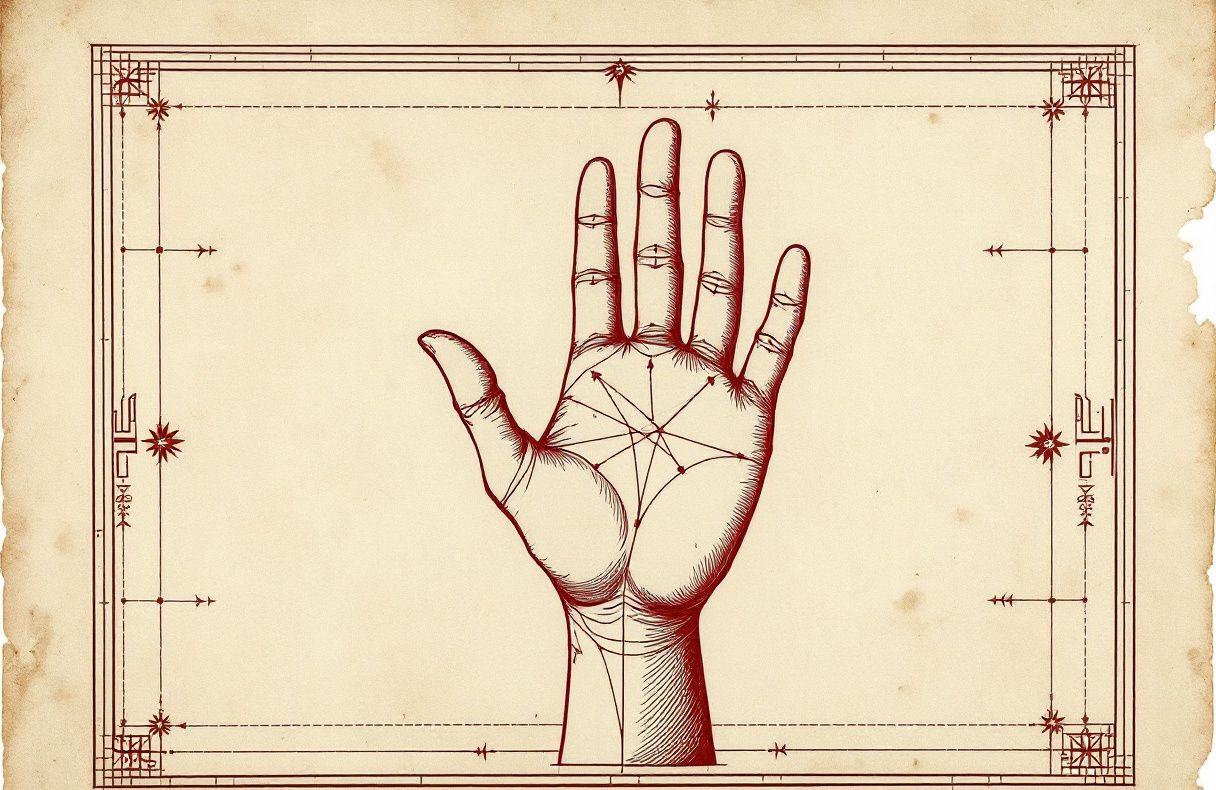
How a palm reading from a photo works here
Most palm reading apps work in one step. A model looks at your photo and writes whatever comes to mind, in one breath, with nothing checking it. The result reads smoothly and means little, because no sentence is tied to your actual hand.
Hasta splits the work into two passes that are never allowed to blur.
The first pass only looks. It goes through your photo against a fixed checklist: the major lines and where each one starts, stops, forks or breaks, the marks between them, the fingerprint patterns, the mounts and which of them lead, the proportions of the fingers and thumb. It outputs a plain list of the features it found, where each one sits, and how clearly it is visible, graded as a confidence level. It writes no prose at all.
The second pass writes, and it writes under a rule: it may compose only from the features the first pass detected, matched against one fixed canon of meanings. It cannot invent a feature. If the looking pass found no mark on your Sun line, no sentence about a mark on your Sun line can exist in your reading. The writer's job is composition, not imagination.
Every claim is anchored to your hand
Every sentence in a Hasta reading has the same skeleton: because of this feature on your hand, this reading. The feature is named. So you can hold your own palm up to the light, find the fork or the island or the whorl the sentence points at, and judge for yourself. If you cannot find it, the reading has failed and you are right to say so.
That is deliberate. A reading you cannot check is not a reading, it is flattery. Anchoring every claim to a visible feature makes the whole thing falsifiable by the one person holding the evidence: you.
Why palm readings all sound the same
Here is the open secret of the trade, boardwalk and app alike. Most readings are written from hand shape and the three big lines: a squarish or longish palm, a heart line, a head line, a life line. Nearly every hand on earth offers those, and they come in a handful of common forms, so the sentences they generate fit nearly everyone. That is why your reading sounds like your friend's.
Hasta composes from the other end of the hand, the features where hands actually differ. The marks between the lines. The fingerprint patterns, which are set before birth, never change, and are measurably common or rare. The events along a line: an island here, a fork there, a break that is bridged. The ranking of the mounts, the fleshy pads at the base of each finger. The measured proportions of the fingers and thumb. A Hasta reading is composed from many detected features of this kind, never from shape plus three lines alone.
Specificity makes it personal. Rarity makes it checkable: when a reading says your ring finger carries a double loop whorl, a pattern found on only a few prints in a hundred, that figure is either on your finger or it is not.
One canon, many sources
The meanings themselves come from one place: a canon built by reading the source traditions side by side and making one editorial decision per feature. In went the careful Western books, Benham's Laws of Scientific Hand Reading, d'Arpentigny's hand types, Cheiro. In went the Indian tradition, Sen's Hast Samudrika Shastra and the palm chapter of the Garuda Purana, which carry the mark catalogue, the fish, conch and lotus, that Western books barely know. The name Hasta itself is the Sanskrit for hand, हस्त. The Indian school has its own guide. In went the Chinese three line doctrine, which reads a line's depth rather than its length. And in went modern population studies, which give honest numbers for fingerprint patterns and crease variants.
Out came one voice per feature. The same feature means the same thing in every Hasta reading, every time, which is more than a model freestyling from its training data can promise. And where the traditions genuinely disagree, the canon says so instead of averaging them into mush. A clean cross under the index finger is a happy union in Sen and a defect in Benham: a Hasta reading will tell you both, named, rather than serve the smeared midpoint of the two. The full register of texts, and how such conflicts were settled, is on the sources page.
Honesty as machinery, not a footnote
Honesty in Hasta is not a disclaimer pasted at the bottom. It is load bearing, in four places.
- Tradition is labeled as tradition. When a reading says tradition holds, or Benham wrote, or the Samudrika texts say, that is a claim inside a symbolic system, offered as a mirror for your own self knowledge. The few measured facts, like fingerprint pattern frequencies, are labeled as evidence, and there are not many of them.
- Confidence gates assertion. What the looking pass saw clearly, the writer asserts. What it saw faintly, the writer hedges, with words like appears and suggests. What it could not see, it leaves out or says straight: we could not see this.
- A reading is a mirror, not a verdict. It speaks of character and tendency, themes and seasons. It does not hand down outcomes, and it does not tell you who to be.
- Hasta checks its own writing. Before a reading reaches you, its sentences are held against one question: would this fit anyone? The warm, general, horoscope shaped sentence that flatters every reader is the oldest trick in this trade. Hasta hunts it in its own output and rewrites it until the sentence could only be about the hand in the photo.
What Hasta will not read
Some things the old books contain and Hasta will not say, no matter what your hand shows. It will not tell you how long you will live, and it will not put dates on your life. It will not read your body or hand down health verdicts. It has no remedy, no charm and no upgrade to sell you against a bad sign, because it does not deal in bad signs of that kind. And it will not weigh anyone's worth. If a reading needs those things to feel powerful, it was never reading your hand in the first place.
One photo, then it is gone
A reading is written from one photo of your palm. The photo goes to our server and to Anthropic's Claude, which reads it. Once the reading is written, the photo is deleted. A small, low resolution thumbnail stays with the reading so you can see which hand it came from, deliberately too small for details like fingerprints to be legible.
There is no account to make, no password, and no email ever required. No advertising pixels, and no selling or sharing of readings with anyone. Google Analytics and Microsoft Clarity run only if you tap Accept on the banner, so we can see which pages help, and the text of your reading is hidden from them. The full accounting, down to every cookie that can exist and the case that sets each one, is on the privacy page.
Questions people ask
How does a palm reading from a photo work?
At Hasta it works in two passes. A looking pass goes through your photo against a fixed checklist and lists only the features it can actually see, each with a confidence level. A writing pass then composes the reading from those detected features and one sourced canon of meanings. The writer cannot invent a feature, so every sentence traces to something visible on your hand.
Is a palm reading from a photo accurate?
Palmistry itself is a tradition, not a validated science, and no honest app should tell you otherwise. What Hasta guarantees is different: every claim traces to a feature visible in your photo and to a sourced meaning in its canon. Tradition is labeled as tradition, and the few measured facts are labeled as evidence. The reading is accurate about your hand. What the tradition makes of your hand is a mirror to think with, not a verdict.
Is my photo kept?
No. The photo is used to write one reading and is deleted once the reading is written. A small, low resolution thumbnail is kept with the reading so you can see which hand it came from, deliberately too small for details to be legible. There is no account, and no analytics unless you accept them. The full accounting is on the privacy page.
Why do palm readings from apps all sound the same?
Because most are written from hand shape and the three big lines, which nearly every hand shares in a handful of common forms. The sentences those features generate fit almost anyone. Hasta composes instead from many detected high variance features, such as marks, fingerprint patterns, line events, mount ranking and finger measurements, which is where hands actually differ.
What will Hasta never tell me?
How long you will live, dates for events in your life, anything about your health or your body, and anything that weighs a person's worth. It also has nothing to sell you against a bad sign. These limits hold no matter what a source text says, and no matter what your hand shows.
See it on your own hand
Hasta reads a photo of your palm and writes a reading from the lines it can actually see. Every claim is anchored to a feature it names, so you can hold the reading against your own hand and judge it. The photo is deleted after the reading.
Read next
Palmistry is a symbolic tradition, not a validated science. Hasta reads character and tendency, never health, lifespan or dated events. A mirror, not a verdict.