Samudrika Shastra: the Indian study of the hand
What Samudrika Shastra is, which texts Hasta's Indian canon actually comes from, and what we refuse to serve from them. Palmistry is a tradition, not a validated science: a mirror, not a verdict.
What Samudrika Shastra is
Samudrika Shastra, सामुद्रिक शास्त्र, is the classical Indian study of bodily marks. Its claim is larger than palmistry: the whole body, from the set of the brow to the arch of the foot, is a text, and a trained eye can read character and fortune in it. Hast samudrika, the hand branch, is the part of that study concerned with the palm: its lines, its mounts, and above all its marks.
Say plainly what this is. It is a tradition, centuries deep and culturally alive, not a validated science. Hasta serves it the way a good museum serves its collection: faithfully, with labels, and with the dangerous pieces kept behind glass. This page shows you the shelf the Indian half of our canon sits on, and it shows you the glass.
The texts behind Hasta's Indian canon
When Hasta cites the Samudrika tradition, it is citing specific books, read in full, not a vague gesture at ancient wisdom. The working spine is K.C. Sen's Hast Samudrika Shastra, the most systematic compilation of the Hindu school available in English, the book that locates the temple mark on Tagore's palm and the renunciate's line on Gandhi's. Beside it sits chapter LXV of the Garuda Purana, a short, old catalogue of the marks of hands and feet.
Sen was himself a compiler, and he names his sources. Behind his book stands the deeper Sanskrit layer: Varahamihira's Brihat Samhita, the Samudrika Chintamani, the Brihat Samudrika Shastra, and the Hasta Sanjivani. When a Hasta reading says the texts hold something, it is because one of these holds it, and we can point to the page.
The lines wear different names here
Here is a detail most palmistry websites smooth over, and it is worth your trust that we do not. The Indian school and the Western school read the same three big creases, but they name them differently, and the names cross.
Sen's Hindu register calls the crease the West knows as the heart line the आयु रेखा, Ayu Rekha, the line of life. The Western head line is the मातृ रेखा, Matri Rekha, the mother's line, read also for wealth. And the Western life line, the arc around the thumb, is the पितृ रेखा, Pitri Rekha, the father's line, the line of family. A book that blends the two schools without noticing will tell you your life line is your heart line and never know it did.
Hasta made one editorial decision and holds to it: the Sanskrit names are the primary labels, each carried with its Western function alongside, and the two registers are never mixed inside one reading. One line, one name, every time.
The chinha: the auspicious marks
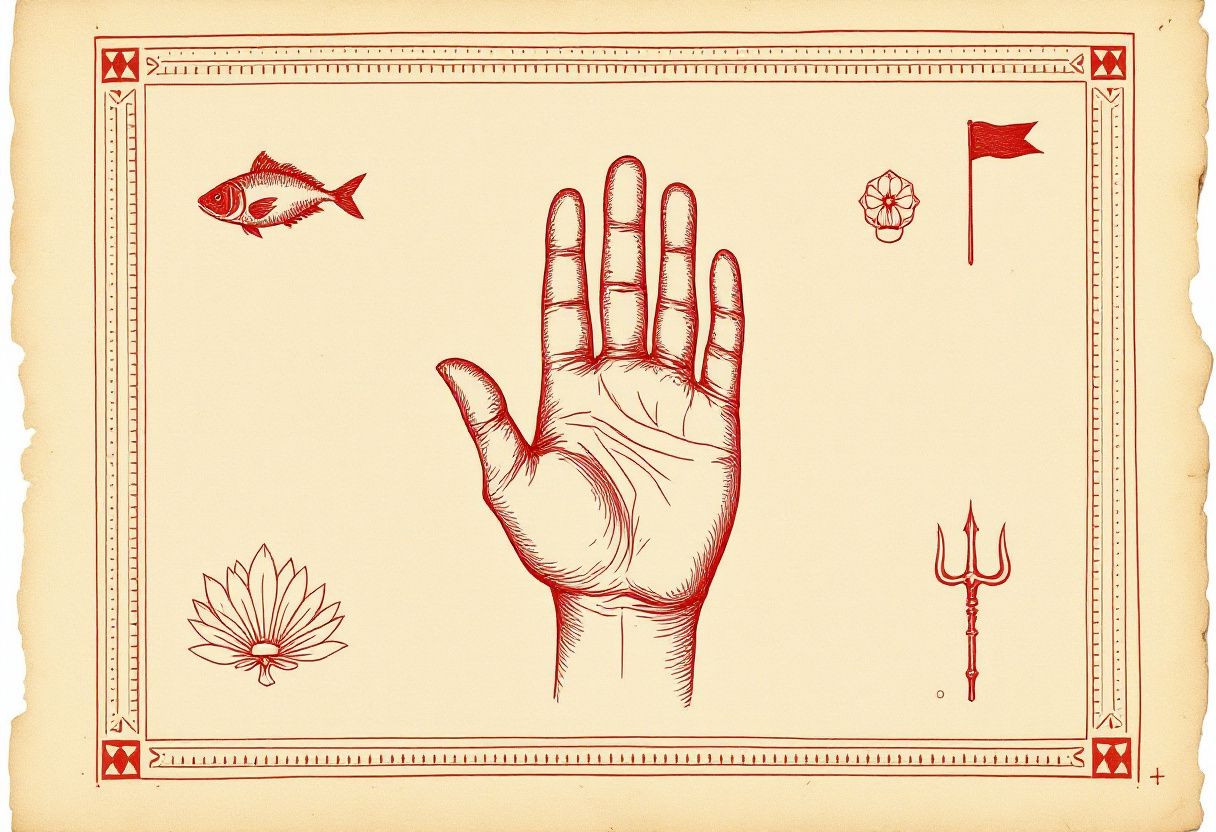
The layer that makes the Indian school unlike any other is the chinha, the catalogue of shaped marks. Sen states a doctrine the West has no real equivalent for: marks can outrank lines. He explains men of great fortune whose fate lines are faint by the marks they carry, and holds that a strong mark may headline a hand whose lines are ordinary. A few of the auspicious ones, with the readings the texts give them:
- Matsya, मत्स्य, the fish: the supreme fortune mark, read for wealth, authority, charity and scholarly fame. It sits above the wrist, and the texts even read its direction: facing the fingers, prosperity through life; facing the wrist, benefits that arrive late.
- Shankha, शंख, the conch: rare, read for greatness joined to purity, and on the Mercury or Moon regions for deep learning.
- Padma, पद्म, the lotus: rare and avatar grade, read for great wealth and great goodness together, one of Sen's four signs of greatness.
- Trishula, त्रिशूल, the trident: the near universal mark of the successful. A heart line ending triple forked under the index finger is, in Sen's words, a magnificent sign.
- Dhwaja, ध्वज, the flag: strength of character and riches; under the little finger, the mark of the philosopher.
- Kalasha, कलश, the pitcher: wealth, and another of the four greatness marks.
- Swastika, स्वस्तिक, in its Indian sense, millennia older than its theft: good fortune and spirituality, found, Sen writes, on the hands of saints.
The texts carry adverse marks too. Where their readings are mild, Hasta serves them softened; where they are not, they fall under the refusals below.
The 32 marks, honestly
You will meet the claim that scripture lists 32 auspicious marks on the palm. The source behind that number is the Lakkhana Sutta, a Buddhist discourse listing the 32 marks of a Great Man, and here is the honest version: those are whole body marks. Long fingers and soft hands appear in the list, and so do net like lines on the palms, but the famous wheel mark sits on the soles, not the hands. The palm version came later, through the iconography of the avatars, whose painted hands carry the conch, the lotus, the wheel and the flag. That transfer is where the popular trope comes from. Hasta uses the framing of the auspicious marks of the avatars, and never claims the Sutta lists palm marks, because it does not.
Rahu and Ketu: modern, and labeled so
Modern Indian palmistry reads two mounts named for the shadow planets: Rahu in the hollow of the palm, Ketu at its base above the wrist. Neither appears in Sen, and neither appears in the Garuda Purana. They come from modern Hindi language Vedic palmistry, and they are good material: culturally alive, distinctive, and well suited to the palm's least examined regions. Hasta keeps them. But it labels them modern Vedic, never shastra, for the same reason it will tell you that the popular earth, air, fire and water hand types date to a book from 1965. A tradition is only worth citing if you cite it straight.
What the old texts say that we will not serve
Reading these books in full means reading their cruelty too, and honesty means naming what we cut rather than pretending it was never there. The texts time a death from the length of a line and count out a lifespan from the wrist bracelets: Hasta refuses every such reading, timed or untimed. They deliver organ by organ disease verdicts: we serve no disease reading and no medical framing of any kind. They carry the stri-lakshana judgments of women, widowhood marks among them: refused whole. They read caste and servitude from a palm: refused. They issue fertility verdicts and count sons: refused. They brand palms with marks of thieves and cheats: Hasta will not defame you to your face, and all of it stays in the archive.
How this feeds a Hasta reading
Everything above lives in one place: a single written canon that every Hasta reading is composed from. Each meaning in it traces to a named source, so nothing is invented on the spot. Where the schools disagree, an editor chose one voice per feature, so your reading never hedges between contradictions. And every claim wears its label: the shastra as shastra, the modern as modern, and the few points where real evidence exists as evidence. When Hasta tells you the texts say something, they do. When they say something we will not repeat, we tell you that too.
Questions people ask
What is Samudrika Shastra?
Samudrika Shastra is the classical Indian study of bodily marks: the idea that the whole body, from the face to the feet, carries readable signs of character and fortune. Hasta samudrika is its hand branch, concerned with the lines, mounts and marks of the palm. It is a tradition, not a validated science.
Is hasta samudrika the same as palmistry?
It is the Indian school of palmistry. It reads the same big creases as the Western school but names them differently, and it adds a layer the West barely has: the chinha, auspicious marks such as the fish and the conch. Hasta draws on both schools and keeps their registers strictly separate.
Which texts is Hasta's Indian canon built on?
The working sources are K.C. Sen's Hast Samudrika Shastra and chapter LXV of the Garuda Purana. Behind them stands the older Sanskrit layer that Sen himself cites: the Brihat Samhita, the Samudrika Chintamani, the Brihat Samudrika Shastra and the Hasta Sanjivani.
Are the Rahu and Ketu mounts in the classical texts?
No. They appear in neither Sen nor the Garuda Purana. They come from modern Hindi language Vedic palmistry. Hasta keeps them because they are culturally alive and useful, but labels them modern Vedic, never shastra.
Does Hasta serve everything the old texts say?
No. The texts contain verdicts we consider harmful: about the span and end of a life, about the body, about the standing of women, about social rank, and about a person's character. Hasta refuses every one of them and says so openly. What reaches you is character and tendency only, anchored to features you can check on your own hand.
See it on your own hand
Hasta reads a photo of your palm and writes a reading from the lines it can actually see. Every claim is anchored to a feature it names, so you can hold the reading against your own hand and judge it. The photo is deleted after the reading.
Read next
Palmistry is a symbolic tradition, not a validated science. Hasta reads character and tendency, never health, lifespan or dated events. A mirror, not a verdict.