The fate line, and the hands that have none
What the fate line reads as, where it begins and ends, and why a palm without one is not missing anything. Palmistry is a tradition, not a validated science: a mirror, not a verdict.
What the fate line is
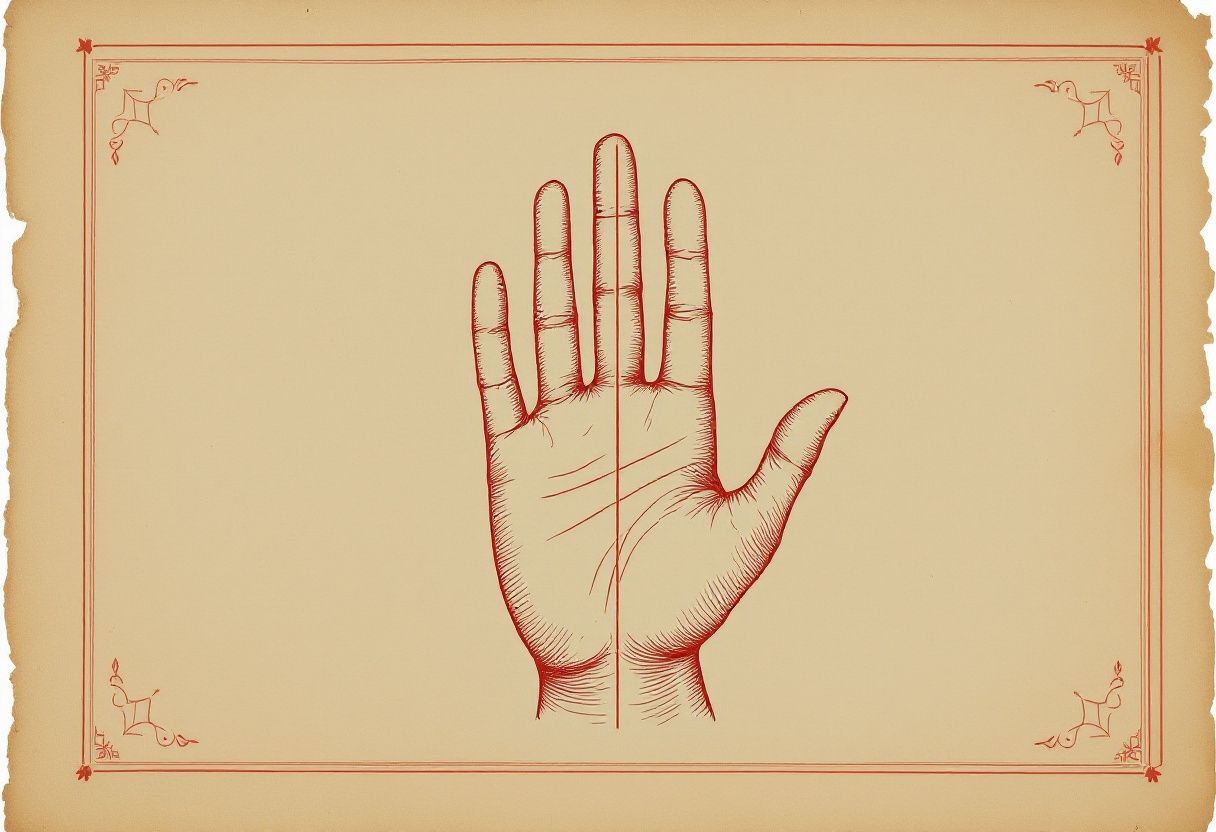
The fate line is the vertical line that climbs the centre of the palm toward the middle finger, the finger of Saturn. Of the major lines it is the one most likely to be missing, the most changeable, and the most misnamed. Despite the name, the tradition's own best teacher did not believe in fate. Benham wrote that we make our fortunes and then call them fate, and he read this line not as destiny but as the record of the material life: work, effort, direction, the shape of a career.
In the Sanskrit register of the Samudrika texts it is the भाग्य रेखा, the Bhagya Rekha: the fortune line. Same territory, same caution. The classical ideal is a line that is clear, even and unbroken, but the texts spend most of their attention on the hands where it is anything but.
No fate line: the self made reading
Many healthy, capable, successful hands simply have no fate line at all. If yours is one of them, here is the tradition's actual reading, and it is worth having: the absent fate line is the mark of the self made. Benham found it missing on many of the most successful hands he examined, and read it as a person who trusts nothing to luck, asks no favours of circumstance, and builds the material life with their own hands.
So absence is a reading, not a lack. A palm without a fate line is not a life without direction. It is a life whose direction was never handed over to anything outside itself.
No dates, ever
You will find readers who run a thumbnail up the fate line and announce the age at which your work will change. Hasta refuses to do this, plainly and on principle. We never attach dates or ages to any line. What the tradition honestly supports is themes and seasons: an early stretch, a middle stretch, a late one, each with its own weather. Where the line starts and where it ends says which seasons were lean and which were full. It never says which year.
Where the line begins
- From inside the life line, near the thumb: the start of the material life assisted by kin. Family gave the first push.
- From the middle of the palm: own effort. The road was cut by the walker.
- From the Mount of the Moon, the pad on the opposite edge of the palm: material success assisted by another person, classically a spouse or partner whose backing makes the career.
- Starting high on the palm rather than near the wrist: the early seasons were lean, and ease arrived late. The line records when the road firmed up, not a date, a season.
Where it ends, and what its branches read as
A fate line that stops at the head line reads as a working life checked by errors of judgment: the current ran well until a decision cut it. One stopped by the heart line reads as feeling overruling business, sentiment allowed to steer what judgment should have.
A line that runs clear through to the Mount of Saturn under the middle finger reads as material steadiness that holds into the late seasons of life. One that bends to end on Jupiter, under the index finger, reads as success through ambition.
Rising branches are the line's best feature. A branch toward Jupiter reads as success by leading people. A branch toward Apollo, under the ring finger, reads as success in art, business or the public eye. Benham calls the combination of both branches the most favourable marking the line can carry. A branch toward Mercury, under the little finger, reads as success by shrewdness. Sister lines running beside the fate line strengthen it; lines cutting across it weaken it.
Breaks and islands
Breaks in the fate line read as checks in the working life. The detail that matters is what the line does next. A break where the line resumes in a changed direction reads as a whole change of life work: not a stumble, a new road. A repaired break, with overlapping ends or a sister fragment bridging the gap, reads as someone who fights through.
An island in the stretch between the head line and the heart line reads as a sustained period of money difficulty. It is worth knowing that an older tradition read that island as betrayal in love, and that Benham examined the claim against real hands and rejected it. The honest reading is narrower and more useful: money, under strain, for a while.
Questions people ask
Is it bad to have no fate line?
No. Benham found the fate line absent on many successful hands and read its absence as the self made hand: a person who trusts nothing to luck and builds the material life by their own effort. Absence is a reading, not a lack.
Can the fate line tell me when my career will change?
No, and we refuse to pretend otherwise. Hasta never attaches dates or ages to any feature. The tradition reads the fate line as themes and seasons in the working life, never as a calendar.
What does a broken fate line mean?
Breaks read as checks in the working life. A break where the line resumes in a changed direction reads as a whole change of life work, and a repaired break, with overlapping ends or a sister fragment, reads as someone who fights through the check.
What does it mean if the fate line starts from the Moon mount?
The tradition reads a fate line rising from the Mount of the Moon as material success assisted by another person, classically a spouse or partner whose backing makes the career possible.
Can a fate line appear later in life?
The tradition says yes. Benham taught that lines change as life leaves its impressions, and the Samudrika texts hold that lines form by karma and move with present action. A palm is a changing map, not a fixed one.
See it on your own hand
Hasta reads a photo of your palm and writes a reading from the lines it can actually see, anchored to features it names, so you can check every claim against your own hand. Your photo is deleted after the reading.
Read next
Palmistry is a symbolic tradition, not a validated science. Hasta reads character and tendency, never health, lifespan or dated events. A mirror, not a verdict.