The head line
What the head line is, where it runs, and what tradition reads in its slope, start, depth and forks. Palmistry is a tradition, not a validated science: a mirror, not a verdict, and never a test.
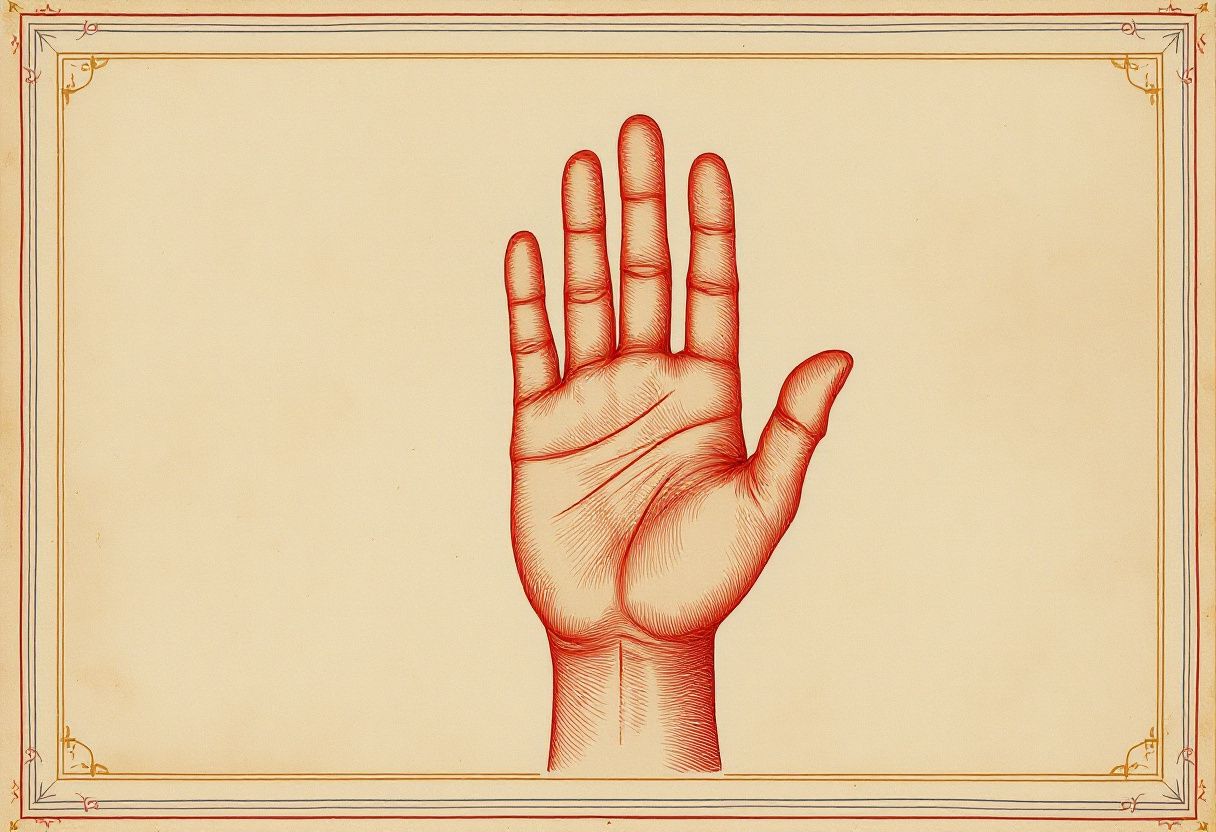
Where the head line sits
The head line is the middle of the three big creases. It begins at the thumb side of the palm, between the thumb and the index finger, and runs across the palm below the heart line, either straight toward the opposite edge or sloping down toward the wrist side.
Its territory in the tradition is thinking: how you decide, how fixed or roaming your ideas are, how your judgment behaves when feeling leans on it. Note the word. How, not how much. That distinction carries this whole page.
One line, three names
In the Samudrika register this is the मातृ रेखा, Matri Rekha, the mother line, and it carries a second name, Dhan Rekha, the wealth line: the line of the money mind. The old Indian school's labels do not map onto the Western ones, so Hasta uses the Sanskrit names as primary labels with the Western function alongside, and never mixes registers inside one reading. Sen's texts add a pleasing detail: a Matri Rekha connected to the Gotra Rekha, the family line, belongs to one who builds new houses.
Chinese palmistry calls it the Human line, 人纹, the middle of the San Cai three, and also the wisdom line, Zhi Hui Xian. Its doctrine: judgment, clarity and character, with a clean line read as sound decisions.
Temperament, not a test
Every claim the canon makes about the head line lives in temperament space: the style of your thinking, never its size. Some modern outfits sell intelligence reports read from the hand, often to parents about their own kids. We think that is false, and a little cruel, and we will not do it in any form. The head line can be read for whether your mind runs straight or wanders, holds one idea or ten. It cannot rank you, and an honest reader will not pretend it can.
Straight head line or sloping head line
A long head line is read as abundant mental activity: appetite for thought, not a capacity ranking. From there the direction takes over.
- Straight: fixed, practical ideas. Very long and perfectly straight is read as practicality in charge and sentiment in the back seat, at its extreme the kind of mind that would claim its pound of flesh.
- Sloping toward the Moon mount: imagination. Benham explicitly rebutted the old slander on the sloping line: it never meant an unsound mind. He held imagination essential to writers and speakers, and read a deep droop as the pull toward fiction and poetry.
- Wavy: no fixed purpose, a mind that changes its road.
- Rising toward the heart line: feeling can overrule judgment at a pinch.
- Running up toward Mercury: money becomes the measure of everything.
Where the head line starts
The start is read as the story of your independence.
- Joined to the life line: the usual form. The longer the two stay joined, the later self reliance is said to arrive. A sharp angle between them: sensitive.
- Separated from the life line: self reliance, independence, courage. A moderate gap is fine, a wide one tips into foolhardy, and tradition adds a paradox: this start is also proud and easily stung.
- Starting inside the life line, on Lower Mars: the enthusiastic starter who picks quarrels and sticks to nothing.
- Starting from the Jupiter mount: leadership. Benham's phrase is worth keeping whole: rules while seeming to be ruled.
Forks at the end: the writer's fork
A fork at the end of the head line is one of palmistry's best loved readings: the writer's fork, versatility, the practical and the imaginative view held at once. The tradition is funny about its excess: when the prong toward the Moon is itself double forked, it reads the habitual exaggerator, the storyteller who cannot resist improving the story.
A triple fork toward Mercury, Mars and Moon is read as business sense, grit and imagination together, and its owner as generally successful. Small rising splits along the line are aspiration toward whatever mount they point at. Drooping splits are read as the opposite cast of mind, the one that says I am unlucky.
Depth and texture
- Deep and clear: concentration, memory, an even temper.
- Thin: clever, but strain averse. A mind that works best in short bursts.
- Broad and shallow: the tradition is blunt here and calls it a lazy mind. We would say: a mind that thinks when it must.
- Chained: laboured thought, effort behind every conclusion.
All of this is tradition holding forth, marked as tradition in our canon. The right use of it is the mirror: read the claim, hold it against what you know of yourself, keep what rings true.
Two head lines
Rarely a palm shows two distinct head lines. Cheiro read it as two mental natures, one shown to the world and one kept hidden, and as a sign of great capacity. It is uncommon enough that a reader who finds one should say so plainly and then tread lightly.
The balance of the three lines
Chinese doctrine reads the head line as one of three. Heaven, the heart line, for feeling. Human, the head line, for judgment. Earth, the life line, for constitution. All three deep and in proportion is read as harmony among feeling, thinking and vitality, and the one markedly weaker or chained marks that domain as the life's friction point. The Samudrika ideal agrees: the three great lines clear, even, deep and unbroken.
What an honest reader will not claim
No intelligence measurement, ever: no scores, no rankings, no maps of what sits inside anyone's skull. No destiny from a single feature: Benham's own rule was to weigh everything and snap judge nothing, and we keep it. A star on the head line, which older books treated darkly, we serve only as a softened note, a jolt at that stretch, or not at all. The head line describes how you think. What you do with that is yours.
Questions people ask
Which line on the palm is the head line?
It is the middle of the three big creases. It starts at the thumb side of the palm, between thumb and index finger, and runs across the palm below the heart line. In the Chinese San Cai scheme it is the Human line, and in the Samudrika register it is the Matri Rekha.
What does a straight head line mean, and a sloping one?
Tradition reads a straight head line as fixed, practical ideas, and at its extreme as practicality with sentiment pushed to the back seat. A head line sloping toward the Moon mount is read as imagination. Benham explicitly rebutted the old slander on the sloping line: it never meant an unsound mind, and he held imagination essential to writers and speakers.
What does it mean if the head line is separated from the life line?
A separated start is read as self reliance, independence and courage. A moderate gap is read as fine, a wide gap as foolhardy, and the tradition adds a paradox: the separated start is also proud and easily stung. The joined start is the usual form, and the longer the two lines stay joined, the later self reliance is said to arrive.
What is a fork at the end of the head line?
Palmists call it the writer's fork: the practical view and the imaginative view held at once, which is versatility. A triple fork toward Mercury, Mars and Moon is read as business sense, grit and imagination together, and tradition calls that owner generally successful.
Does a short or faint head line mean low intelligence?
No. Palmistry cannot measure intelligence, and honest palmistry never tries. Tradition reads a thin head line as a mind that is quick but dislikes strain, which is a claim about temperament, not capacity. Nothing on a palm is a test score.
See it on your own hand
Hasta reads a photo of your palm and writes a reading from the lines it can actually see. Every claim is anchored to a feature it names, so you can hold the reading against your own hand and judge it. The photo is deleted after the reading.
Read next
Palmistry is a symbolic tradition, not a validated science. Hasta reads character and tendency, never health, lifespan or dated events. A mirror, not a verdict.