The heart line
What the heart line is, where it sits, and what tradition reads in its length, forks and chains. Palmistry is a tradition, not a validated science: a mirror, not a verdict.
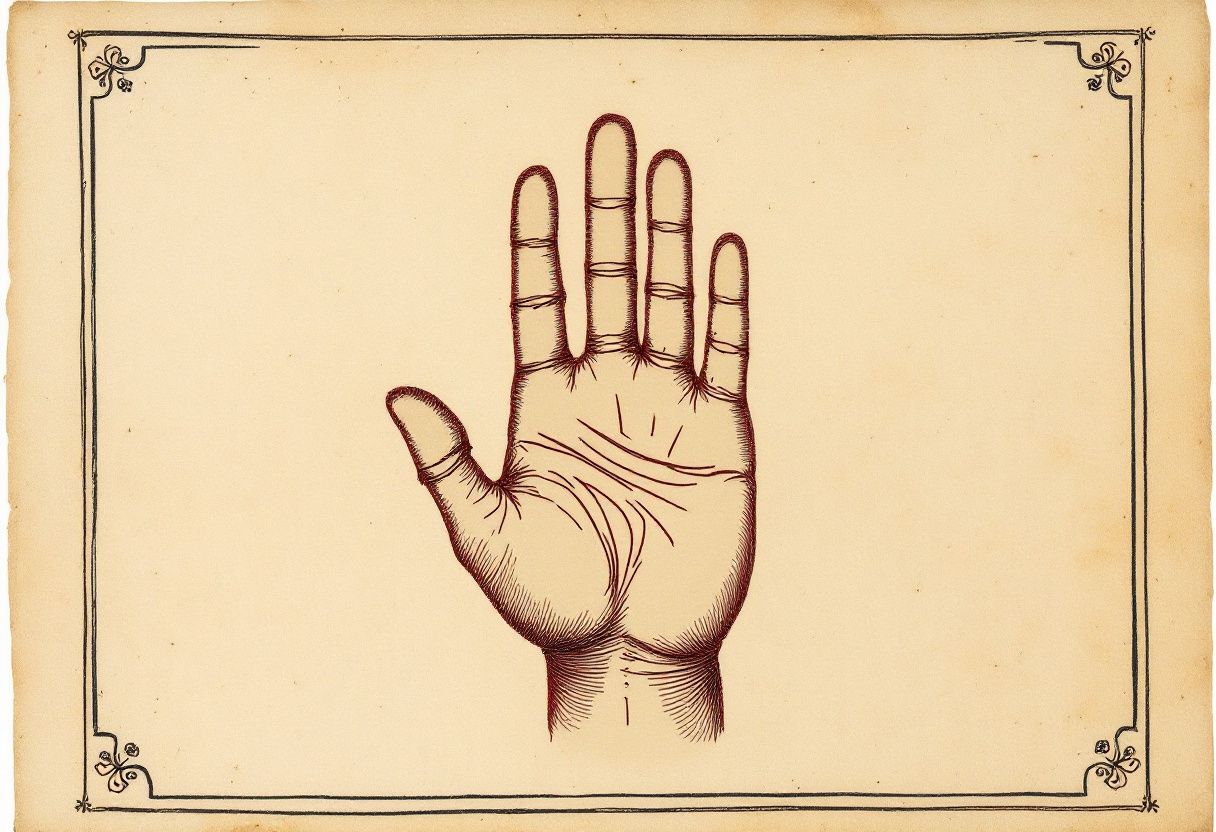
Where the heart line sits
Open your hand and look just below the fingers. The topmost of the three big creases, running from under the index or middle finger across to the edge of the palm below the little finger, is the heart line. Benham, the most careful of the Western palmists, traced it from the index side: its start is read for where your affection comes from, and its end for how far your warmth carries.
Everything tradition says about this line lives in one territory: affection. How you attach, how openly you show it, what it costs you. Not your body, not a timetable, not your future spelled out. Those limits matter, and we come back to them at the end.
One line, three names
In the Samudrika register the heart line is the हृदय रेखा, Hriday Rekha, the heart's line. One honest note on naming: the old Indian school's labels do not match the Western ones. Sen's Hindu register also calls this same crease the Ayu Rekha, a name Western books attach to a different line entirely. Hasta uses the Sanskrit names as primary labels with the Western function alongside, and never mixes the two registers inside one reading.
Chinese palmistry calls it the Heaven line, 天纹, the first of the San Cai three, and also the emotion line, Qing Gan Xian. Its doctrine is simple: this line is your emotional foundation, and a clear, unbroken Heaven line is read as emotional stability.
Where the heart line begins
Tradition reads the starting point under the fingers as the flavour of your affection.
- Under the index finger, the Jupiter mount: an idealist's adoration. You love what you can look up to.
- Between the index and middle fingers: sensible, grounded affection. Benham liked this start best and was blunt about why: love in a cottage without bread is a myth.
- Under the middle finger, the Saturn mount: physical warmth leads the attachment.
A forked start is read generously: sentiment, sense and passion all present, with the deepest prong telling which one leads.
What a long heart line means
A long heart line is welcomed, but the tradition has a ceiling. A heart line crossing the entire palm, edge to edge, is read as too much heart: affection so large it can turn possessive, prone to jealousy, and quick to suffer when it is not repaid.
A shorter line is read by where it gives out. Stopping under the middle finger is read as warmth gone cold. Stopping under the ring finger: beauty rules your loves. Running high onto the little finger's mount is the sharpest read in the book: money must be visible before love arrives. And a heart line that bends down and merges into the head line is read as the head having swallowed the heart, so that judgment wins every argument with feeling.
Depth, breadth and chains
Benham read a line's texture as its character.
- Deep and clear: constant, undemonstrative devotion. Love that does not perform and does not quit.
- Thin: little real warmth behind the manner.
- Broad and shallow: the sentimentalist. Violent starts, quick fades.
- Chained, a run of tiny links: vacillating affection, feeling that wavers.
These are tradition's readings, not measurements. The right use of them is to check each one against your own history and keep what rings true. That check is the whole point of a mirror.
Branches, forks and the triple fork
Small branches carry direction. Rising branches are read as attraction toward whatever the mount above them stands for. Falling branches, in Benham's phrase, are the head's victories over the heart.
A forked heart line is read warmly: affection that reaches many people. The Samudrika register goes further. Its ideal heart line ends on the Jupiter mount in a triple fork, the trishula, or in a lotus, and Sen calls a heart line ending triple forked under the index finger a magnificent sign. All of this is tradition holding forth, and we serve it as exactly that.
Breaks, islands and repairs
Islands, dots and breaks in the heart line are all read the same way: weakened stretches of affection, a span where the current ran thin. The old books also attached readings about the body to these marks. We have cut those entirely and serve only the character residue. Hasta makes no claims about your body, full stop.
One mark earns special trust. A square touching a break is read as protection: the damage contained, the current held. Western, Samudrika and Chinese palmistry all agree on the square, which makes it the highest confidence mark in our canon.
When heart and head are one line
Some palms have no separate heart line at all: one single crease crosses where heart and head usually run apart. This is a real, measured human variant, found in roughly 1.5 to 3 percent of people, and it is a trait, not a flaw. Palmists read it as head and heart running on one track. It has its own guide.
The balance of the three lines
Chinese doctrine never reads the heart line alone. The San Cai scheme sets three lines side by side: Heaven, the heart line, for feeling. Human, the head line, for judgment. Earth, the life line, for constitution. All three deep and in proportion is read as harmony among feeling, thinking and vitality, and one line markedly weaker or chained marks that domain as the life's friction point. The Samudrika texts say something similar from the other side: the three great lines clear, even, deep and unbroken is the ideal palm.
What an honest reader will not claim
Here is where we part company with the boardwalk. The old books hold counting rules at the palm's edge that promise to number unions and date them. Benham examined that counting a century ago and called it inaccurate and unscientific, and we follow him. We do not predict whom or when. We do not count anything about your future family. We do not read this line for your body.
Everything above, unless we said otherwise, is tradition: meaningful as a mirror held up to your own self knowledge, worthless as prophecy. The few things in palmistry that are evidence, like the crease variant frequency above, we label as evidence. The rest is a conversation with a very old tradition, and we keep that conversation honest.
Questions people ask
Which line on the palm is the heart line?
It is the topmost of the three big creases, running beneath the fingers from the index side of the palm across to the edge below the little finger. In the Chinese San Cai scheme it is the Heaven line, and in the Samudrika register it is the Hriday Rekha.
What does a long heart line mean?
Tradition welcomes a long heart line, but with a ceiling. A line crossing the entire palm is read as too much heart: affection so large it can turn possessive, prone to jealousy, and quick to suffer when it is not repaid. This is tradition, not a tested fact.
What does a broken or chained heart line mean?
Benham read chaining as affections that waver, and breaks or islands as weakened stretches of feeling. A square touching a break is read as protection that contains the damage. None of this is a verdict, and none of it is a claim about your body.
Can the heart line tell me when I will marry?
No. The old books hold counting rules at the palm's edge, and Benham himself called that counting inaccurate and unscientific. We do not predict whom or when. The heart line is read for how you love, never for a date.
What if my heart line and head line are one single line?
A single crease crossing where heart and head usually run apart is a normal human variant, found in roughly 1.5 to 3 percent of people. Palmists read it as head and heart running on one track. It is a trait, not a flaw, and we make no health claims about it.
See it on your own hand
Hasta reads a photo of your palm and writes a reading from the lines it can actually see. Every claim is anchored to a feature it names, so you can hold the reading against your own hand and judge it. The photo is deleted after the reading.
Read next
Palmistry is a symbolic tradition, not a validated science. Hasta reads character and tendency, never health, lifespan or dated events. A mirror, not a verdict.