The life line: what it really tells you
What the life line actually reads, where the famous myth about its length came from, and what its sweep, depth and breaks mean. Palmistry is a tradition, not a validated science: a mirror, not a verdict.
First, the myth: length is not lifespan
This is the most asked question in all of palmistry, so let us answer it before anything else. A short life line does not mean a short life. The line's length is not a measure of your years, and no honest reader will pretend it is.
You do not have to take our word for it. William Benham, the most rigorous teacher the Western tradition produced, wrote in 1900 that a reader should never make that prediction. He had examined hands that disproved the rule, and he held that a strong will, a firm thumb and a clear head line outweigh the poorest life line on the palm. The correction is over a century old. The myth has simply outlived it.
Hasta goes further: we never read lifespan at all, from any feature, under any phrasing. What the tradition actually assigns to this line is something more useful anyway: how you live, not how long.
What the life line actually reads
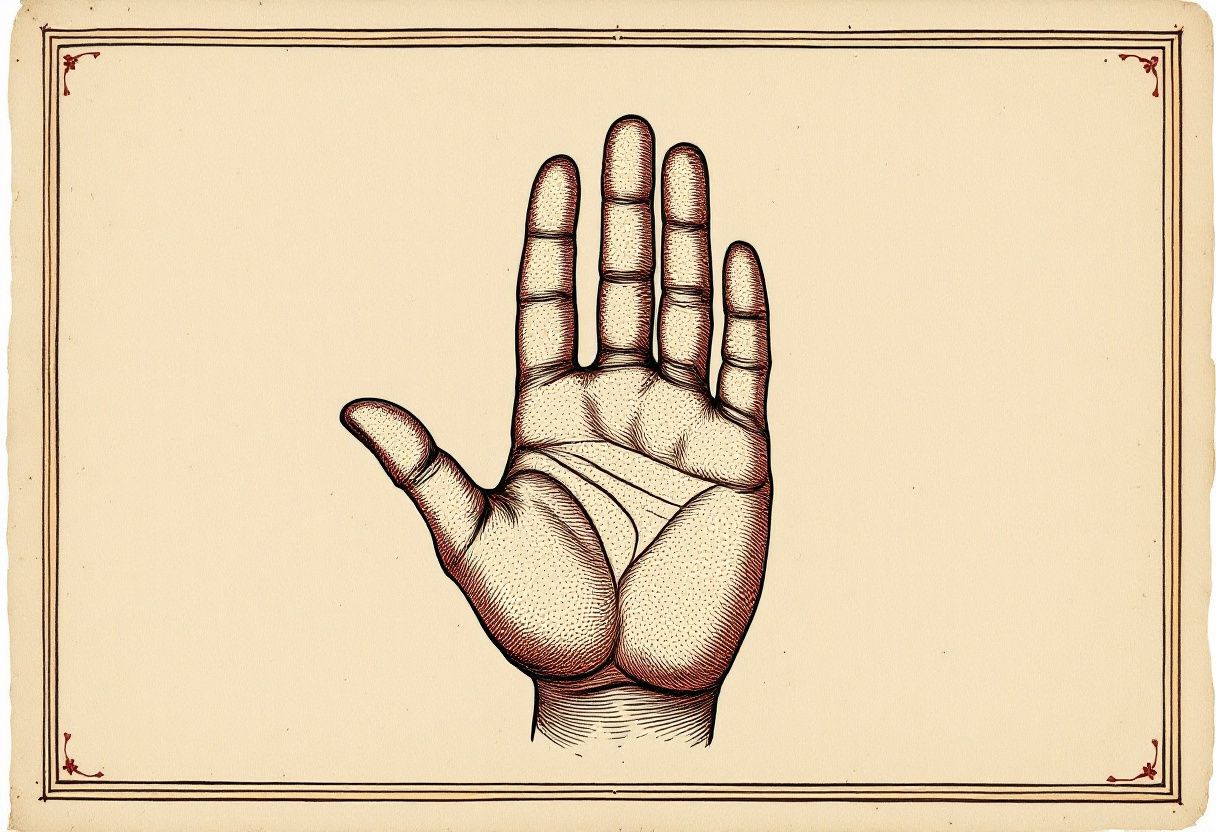
The life line is the curve that wraps around the ball of your thumb, starting between thumb and index finger and sweeping down toward the wrist. In the tradition it is the line of vitality: the energy you were given and the way you spend it. Warmth, stamina, generosity of effort, the pace at which you burn.
In the Sanskrit register of the Samudrika texts this is the पितृ रेखा, the Pitri Rekha: the father line, the line of family and root. One classical manual, the Samudrik Tatak Sudhakar, names eleven distinct kinds of it, which tells you how much attention the tradition paid to this single curve.
A life line that rises from under the index finger, from the Mount of Jupiter, is read as a life driven by ambition from the very start: the energy has a target before it has a plan.
The sweep: wide or close
Before depth, look at the arc itself. A life line that sweeps wide into the palm, giving the thumb's mount plenty of room, is read as an ardent, generous, magnetic nature with a strong constitution: energy that reaches outward and warms other people.
A line that hugs close to the thumb reads the opposite way: vitality held near, warmth given carefully, a person who spends themselves in measured amounts. Neither is a flaw. One is a bonfire, the other a lamp.
Depth and texture
- Deep and clear: muscular vigor. Stamina, appetite for work, quick recovery.
- Thin: nervous energy rather than muscular. It is real energy, but it must be budgeted: such a hand does its best work in bursts and needs honest rest between them.
- Broad and shallow: energy that leaks. Benham's blunt read was the chronic complainer: a tendency to feel put upon by efforts that a deeper line would barely notice.
- Chained at the start: completely normal. The tradition reads the chained opening as the ordinary turbulence of childhood years, not a defect.
Branches, and the high summer of the line
Fine hairlines rising off the life line are read as the ascending years: effort climbing, strength gathering. The point along the line where rising branches stop and drooping ones begin is read as the zenith of one's powers, the high summer of energy. After it, the tradition says, you spend from the store rather than add to it. This is a season, not a date: Hasta never attaches ages to it.
A fork or tassel at the lower end of the line was once read as poverty in old age. Benham rejected that reading outright. The served meaning is simply the natural dispersal of energy in later years: the current dividing into smaller streams, as currents do.
Breaks, bars and islands
An island, where the line splits and rejoins around a small eye shape, reads as a stretch where the current ran lower: vigor divided between two channels for a while, then restored.
Small bars cutting across the line are worry lines: impediments crossing the life, deep ones serious, faint ones mere annoyances.
A break reads as a check in the current. What matters is whether it is repaired. Overlapping ends, a sister fragment running alongside, or a square drawn around the gap all read as repair, and a repaired break is far less serious than an open one. The square deserves its own note: it is the mark of protection, and it is the single mark on which the Western, Indian and Chinese traditions all agree.
The sister line inside
Some hands carry a second, finer line inside the life line, between it and the thumb. The Western books call it the Line of Mars; the Samudrika register calls it the Mangal Rekha. It is one of the best things a life line can have: a second reservoir of constitution, a fighter's reserve. Defects on the stretch of life line it runs beside are held not to bite, because the reserve carries the current past them.
The Samudrika reading adds one condition: the sister should run parallel and a little apart. Pressed too close against the life line, it reads as a combative streak, reserve energy that picks its own fights.
Questions people ask
Does a short life line mean a short life?
No. The length of the life line says nothing about how long you will live. Benham, the strictest teacher in the Western tradition, corrected this reading over a century ago, and Hasta never reads lifespan. The tradition reads the line as vitality: how much energy you carry and how you spend it.
What does a break in the life line mean?
A break reads as a check in the current of energy, a stretch where vitality was interrupted. The tradition treats a repaired break, one with overlapping ends, a sister fragment alongside, or a square around it, as far less serious than an open one.
What is the second line inside my life line?
A fine line running between the life line and the thumb is the sister line, called the Line of Mars in the Western books and Mangal Rekha in the Samudrika register. It reads as a second reservoir of constitution, a fighter's reserve: defects on the stretch of life line it runs beside are held not to bite.
What does a deep life line mean?
Depth reads as physical vigor: muscular energy, stamina, the ability to work hard and recover fast. A thin line reads as nervous rather than muscular energy, real but needing to be budgeted.
Can my life line change?
Yes. Benham taught that lines change as life leaves its impressions, and the Samudrika texts say the same: lines form by karma and move with present action. Your palm is a changing map, which is why a reading is a mirror of now, never a fixed verdict.
See it on your own hand
Hasta reads a photo of your palm and writes a reading from the lines it can actually see, anchored to features it names, so you can check every claim against your own hand. Your photo is deleted after the reading.
Read next
- GuidePalm reading: the complete guide
- GuideThe simian line: one crease doing two jobs
- IndexAll palm reading guides
Palmistry is a symbolic tradition, not a validated science. Hasta reads character and tendency, never health, lifespan or dated events. A mirror, not a verdict.