The simian line: one crease doing two jobs
What it means when the heart line and head line run as a single crease, how rare that really is, and how the tradition reads it. Palmistry is a tradition, not a validated science: a mirror, not a verdict.
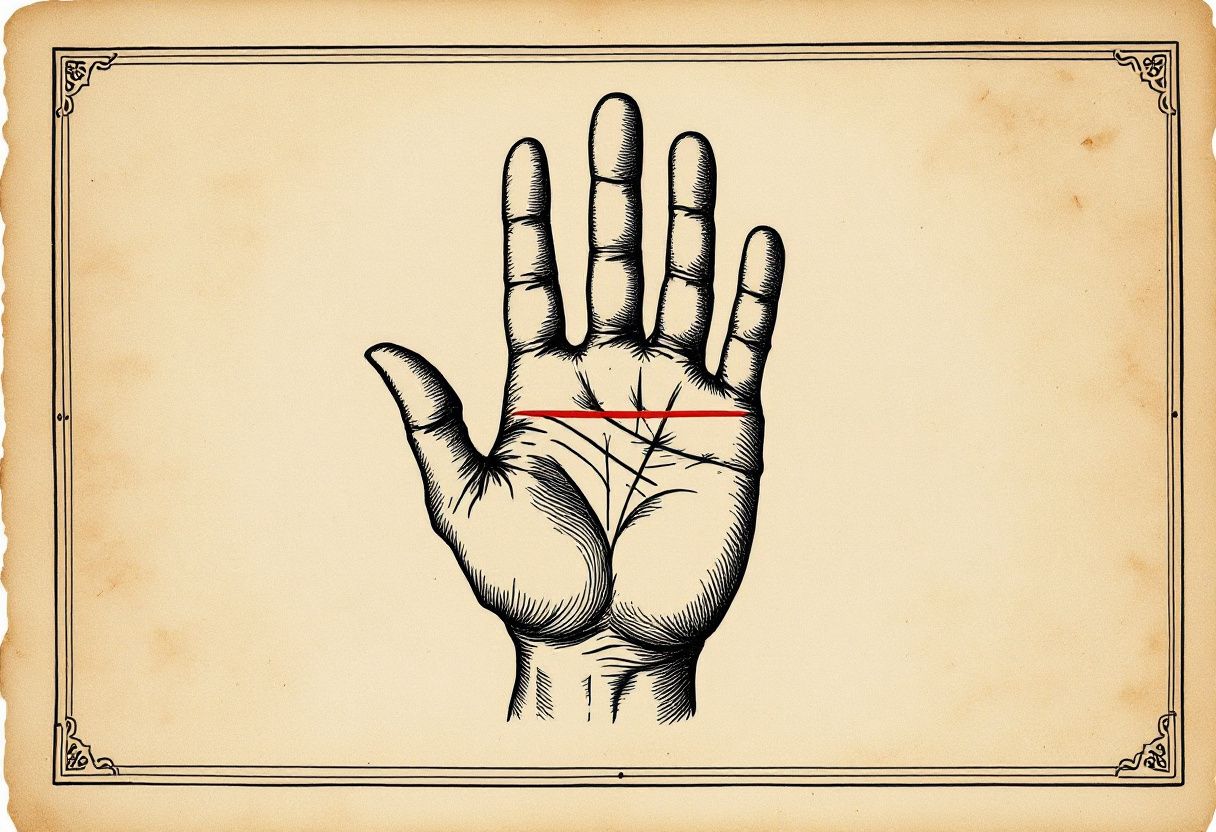
What a simian line is
Open your palm. Most hands show two creases running across it: the heart line above, curving under the fingers, and the head line below it, crossing the middle of the palm. On a hand with a simian line there is only one. A single deep crease runs the full width of the palm, doing the work of both. The plain anatomical name for it is the single transverse palmar crease; the old palmistry books call it the simian line, after an observation about the palms of other primates, and the tradition's own names for it are kinder than that one.
To check for one, look at an open, relaxed palm in good light. The fused form is a single crease crossing cleanly from edge to edge, with no separate heart line above it and no separate head line below. If you can trace two creases that merely touch or cross, that is not a simian line: the two cousins described further down are the likelier match, and they read differently.
Let us say the honest part first, once and plainly: a crease variant is an anatomical trait, not a diagnosis of anything, and Hasta makes no health claims. What follows is what the palmistry tradition reads in it, offered as tradition and nothing more.
How rare it is
Rarity is the one place this page can speak with evidence rather than tradition, because palm creases have actually been counted. The single transverse palmar crease appears in roughly 1.5 to 3 in every 100 people, somewhat more often in some populations than in others. If you carry one, you carry something most people you will ever meet do not.
That figure is a measured number from population studies, not a palmist's flourish. Hasta quotes rarity only when it can be sourced this way, and never invents a statistic.
What the tradition reads in it
The reading rests on what the two missing lines normally divide between them. The heart line carries feeling: affection, warmth, how the emotions attach. The head line carries thinking: judgment, focus, how the mind moves. On a simian hand there is no division. The tradition reads head and heart running on one track: feeling and thinking fused into a single channel.
What does that feel like from the inside, as the tradition tells it? Nothing arrives by halves. A thought comes charged with feeling, and a feeling arrives already reasoned into a position. Where most hands can hold a feeling in one room and a judgment in another, the simian hand holds them in the same room, always. The served readings follow from that single image:
- Intensity of focus. One channel means one current. Whatever such a person turns to receives all of them at once, attention and emotion together.
- Commitment without half measures. Caring and deciding are the same act, so positions are held strongly and changed whole, not shaded.
- Warmth shown in deeds. Benham's register reads the single line in the head line's territory, with thought leading: affection on such a hand tends to be guarded in display and spent through acts, decisions and loyalty rather than through easy demonstration.
As always in the tradition, no single feature is read alone. The old method weighs everything in the scales before the balance is struck: the thumb, the mounts, the texture of the other lines all bend the reading. A simian line on a warm, generous hand and a simian line on a hard one are not read the same way.
The cousins: Sydney and Suwon
The fused crease has two relatives worth knowing, because people who go looking for a simian line often find one of these instead.
- The Sydney line: the head line runs the full width of the palm, edge to edge, while the heart line stays separate above it. Counted at roughly 2 to 3.6 in 100 people depending on population. The palmist's reading: analysis that reaches all the way across, a mind that does not stop halfway through a problem.
- The Suwon crease: the mirror case, where the heart line crosses the palm completely while the head line stays its own. It is the rarest of the three variants.
If your single crease turns out to be a Sydney line rather than a true fusion, the reading changes: that hand still has two channels, one of them simply runs long.
One hand or both
The tradition always reads both hands against each other: the non dominant hand as what you were born carrying, the dominant hand as what you are building. A crease pattern can differ between the two, which is exactly the kind of difference a careful reading leans on. Whatever your hands show, the reading starts from what is actually there, named so you can check it.
Questions people ask
What does a simian line mean in palmistry?
The tradition reads a simian line as head and heart running on one track: feeling and thinking fused into a single channel, so that decisions and emotions arrive together, with great focus and little room for half measures.
How rare is a simian line?
Population studies put the single transverse palmar crease at roughly 1.5 to 3 in every 100 people. That number is measured evidence, not tradition, and it is the only kind of rarity figure Hasta will quote.
Does a simian line mean something is wrong with me?
No. It is simply one of the ways a palm can be creased, found in people with nothing wrong at all. Hasta reads character and tendency only, and makes no health claims from any feature of the hand.
What is a Sydney line?
A Sydney line is a related crease variant in which the head line runs the full width of the palm while the heart line stays separate. It appears in roughly 2 to 3.6 in 100 people, and the palmist's reading is analysis that reaches all the way across.
See it on your own hand
Hasta reads a photo of your palm and writes a reading from the lines it can actually see, anchored to features it names, so you can check every claim against your own hand. Your photo is deleted after the reading.
Read next
- GuideThe life line: what it really tells you
- GuideThe heart line: how you love
- IndexAll palm reading guides
Palmistry is a symbolic tradition, not a validated science. Hasta reads character and tendency, never health, lifespan or dated events. A mirror, not a verdict.