Palm Reading: An Honest Guide
What palmistry is, where it comes from, and what the lines of your hand mean inside the tradition. And it is a tradition, not a validated science: a mirror to think with, never a verdict.
What palm reading is
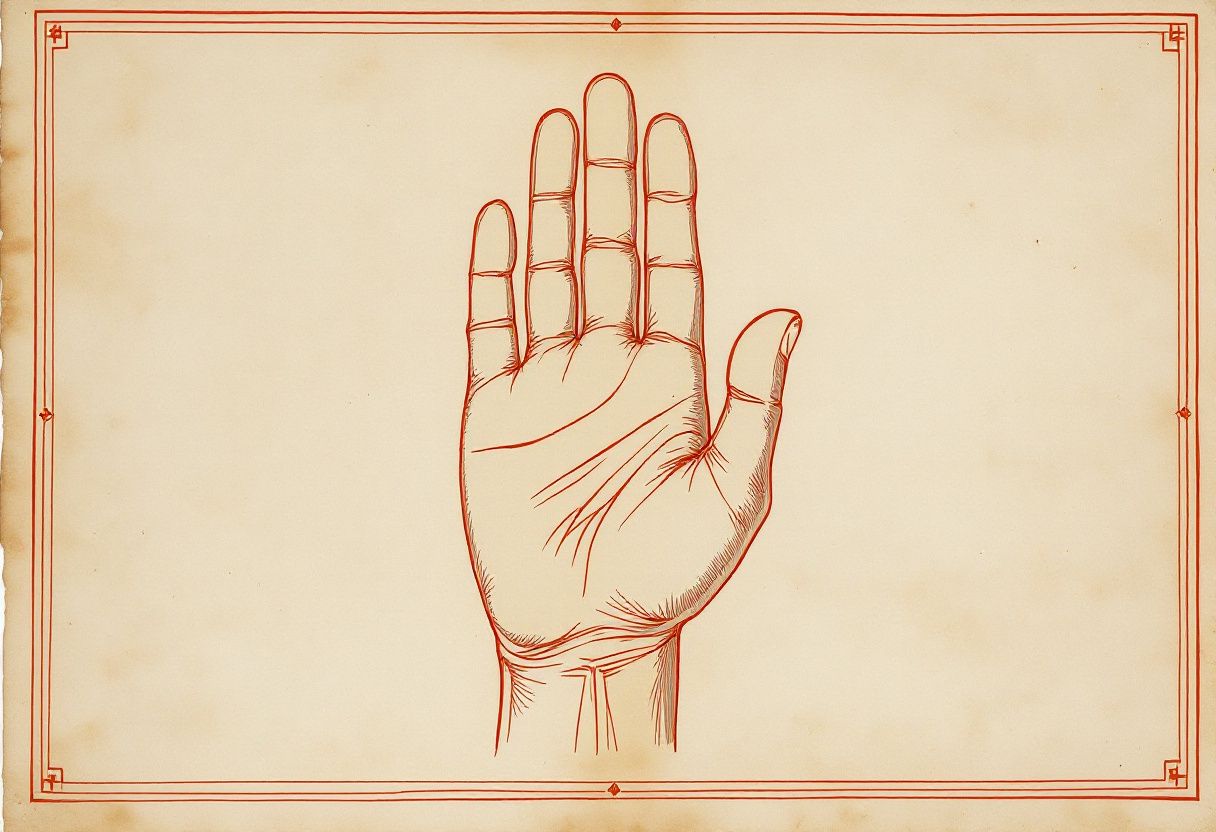
Palm reading, or palmistry, is the practice of reading character from the visible features of a hand: the creases that cross the palm, the fleshy pads under the fingers, the shape of the fingers and thumb, and the small marks scattered between them. People have done this for a very long time, across several civilisations, and that is exactly why it deserves an honest introduction rather than a mystical one.
So here is the honest part. Almost everything palmistry says is tradition: claims handed down inside a symbolic system, not findings from a lab. A small layer is evidence: for example, fingerprint patterns form before birth, never change, and their population frequencies are real, counted data. The meanings, though, are tradition all the way down. Hasta's stance, on every page: a mirror, not a verdict. A good reading names features you can see on your own palm and offers a reading of temperament you can test against your own life. That is its proper use.
Where palmistry comes from
Three great traditions read the hand, and each built its own system.
- India. Samudrika Shastra is the old discipline of reading the body's signs, and hasta samudrika is its branch for the hand. The Garuda Purana devotes a chapter to the marks of the palm, and later texts such as the Brihat Samhita and the Samudrika Chintamani carry the system forward. Its signature is a rich catalogue of auspicious marks: the fish, the conch, the lotus, the flag. The Samudrika Shastra guide walks through the texts and the marks.
- The West. The modern Western line is mostly French and Victorian. d'Arpentigny built a system of hand shapes in 1843. Cheiro made palmistry fashionable with his 1894 book. William Benham's 1900 work is the most systematic of all, and he spent surprising energy correcting popular palmistry rather than flattering it. You will meet his corrections below.
- China. Chinese hand reading frames the same palm its own way: the three great creases become the Heaven, Human and Earth lines, and hands are sorted into types by the five elements. Chinese practice reads the depth of the Earth line rather than its length, which is itself a quiet correction of a popular fear.
The three major lines
The heart line, called Hriday Rekha in the Sanskrit register, is the top crease, running under the fingers. Tradition reads it as your way of feeling. Where it begins matters: starting under the index finger reads as idealism in love, starting between the index and middle fingers reads as grounded, sensible affection. A deep, clear line reads as steady, quiet devotion, a chained one as feelings that waver. The full guide is at the heart line.
The head line, Matri Rekha, is the middle crease. Tradition reads it as the record of how you think. Joined to the life line at its start, it reads as a careful beginning, with self reliance arriving later. Separated, it reads as early independence. A straight line reads as practical and fixed, a line sloping toward the Moon side of the palm as imagination. A fork at its end is the writer's fork: a mind that holds the practical and the imaginative view at once. More at the head line.
The life line, Pitri Rekha, is the curve around the ball of the thumb. Despite its name, the tradition's best writers read it as vigor and warmth, not length of life. A wide, sweeping arc reads as generous, magnetic energy. An arc hugging the thumb reads as more guarded vitality. It records how the engine runs, never how long. The full guide is at the life line.
One note on names: the Sanskrit labels in the Indian texts do not map one to one onto the Western ones, so Hasta picks one register and keeps it, rather than mixing the two mid reading.
What the mounts are
The mounts are the pads of flesh under the fingers and around the palm, named for the planets: Jupiter under the index finger, Saturn under the middle, the Sun under the ring, Mercury under the little finger, Mars in two seats at the palm's sides, the Moon on the outer edge, and Venus on the ball of the thumb. The Indian register knows them as Guru, Shani, Surya, Budha, Mangal, Chandra and Shukra.
Benham's method, which Hasta follows, is to find the leading mount first: the fullest pad, confirmed by a single deep vertical line on it and by the strength of its finger. That leading mount gives the person's basic type, and only then are the lines read, as the record of how that type has run. Type first, lines last. And excess is as bad as absence: an overgrown mount reads as the type's vices, not a double portion of its virtues.
Why so many palm readings feel the same
Because most readings are built from the features everyone has. Every palm carries a heart line, a head line, a life line and a general shape, so a reading built only from those can be poured over anyone, and it is. Swap two people's generic readings and neither would notice. That is not insight, it is a template.
A reading gets personal the moment it is built from what is actually visible on one specific palm: the marks, the fingerprint patterns, the events along each line, which mount leads, how the fingers are proportioned. Hasta composes from at least eight to ten such detected features, and every sentence is anchored: because this feature, which you can find on your own hand, this reading. A claim with no visible feature behind it is just the reader guessing, and you should treat it that way wherever you get your palm read. How Hasta reads a palm shows the method in full.
What palm reading cannot tell you
An honest reader refuses certain claims flat out, because the tradition cannot support them and never could.
- How long you will live. Nobody can read that, and the tradition's own best writers refused to try.
- Anything about your health. A palm is not a test. Hasta makes no health claims at all, in any direction.
- Dated events. "A big change at 31" is theatre. Tradition can speak of themes and seasons, never of dates.
- Counts. How many loves, how many unions, how large a family. Counting readings were always the weakest part of the trade, and Benham called the counting of affection lines inaccurate and unscientific.
- Your worth or station. No reading ranks people.
- Fixes for sale. No stones, no paid rituals. A reading that ends in a product to buy is a sales funnel wearing robes.
Myths the tradition itself threw out
Benham spent much of his 1900 book correcting popular palmistry. Three of his corrections are worth carrying in your pocket. The full shelf behind these pages is on the sources page.
- The short life line. It does not shorten anything. Benham told readers never to make that prediction, and read the line as vigor: how the energy runs, not how far.
- The sloping head line. Older books read a slope toward the Moon as a troubled mind. Benham rebutted that directly: the slope reads as imagination, the standard equipment of writers and speakers.
- The missing fate line. Not misfortune. Benham found the fate line absent on many successful hands and read its absence as the self made person, who trusts nothing to luck.
Questions people ask
Is palm reading scientifically proven?
No. Palmistry is a symbolic tradition, not a validated science. A few facts about hands are measured and real, such as how common each fingerprint pattern is, but the meanings given to lines and mounts are tradition. Read a palm reading as a mirror for reflection, not a verdict.
What are the three main lines in palm reading?
The heart line, the top crease, which tradition reads as your way of feeling. The head line, the middle crease, read as your way of thinking. And the life line, the curve around the ball of the thumb, read as vitality and warmth, not length of life.
Can palm reading predict the future?
No honest reading predicts dated events. The tradition at its best reads temperament and tendency: how you love, think, work and recover. It can name themes and seasons. It cannot tell you what happens next year, and a reader who claims dates is performing, not reading.
Does a short life line mean a short life?
No. Benham, the most systematic of the Western palmists, told his readers never to make that prediction and read the line as a record of vigor instead. A short or faint life line reads as energy that must be budgeted, nothing more.
Which hand should be read?
The traditions differ, but they agree on the useful part: one hand shows what you were born with and the other shows what you are building. Hasta reads your dominant hand, the one you write with, because it carries the more current record.
See it on your own hand
Hasta reads a photo of your palm and writes a reading from the lines it can actually see, anchored to features it names, so you can check every claim against your own hand. The photo is deleted after the reading.
Read next
- GuideWhich hand to read, left or right
- GuideThe life line, honestly read
- IndexAll palm reading guides
Palmistry is a symbolic tradition, not a validated science. Hasta reads character and tendency, never health, lifespan or dated events. A mirror, not a verdict.